


Page 210 - Catalog
P. 210
CABLERAIL BY FEENEY®


                Metal Frame Requirements


                Railing frames need to be designed and built strong enough to support the tension of properly installed cables, which is a load in excess of 300
                lbs for each cable. Here are some basic guidelines to help you properly prepare your railing frames. These guidelines apply whether you are
                using 1/8'', 3/16'' or 1/4'' cable.
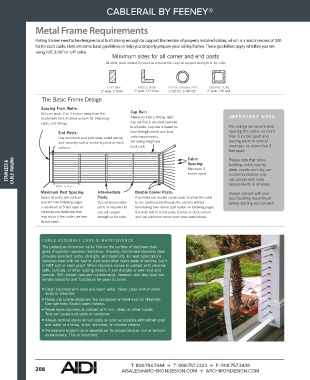
                                               Minimum sizes for all corner and end posts
                                             All other posts should be sized as required for cap rail support strength or for code


                                             FLAT BAR     ANGLE IRON    EXTRA STRONG PIPE   SQUARE TUBE
                                           2" wide, 1" thick   2" wide, 1/2" thick  1-1/2" ID, 1-7/8" OD  2" wide, 1/4" wall
                  The Basic Frame Design
                  Spacing From Walls:
                  Set end posts 3 to 4 inches away from the  Cap Rail:
                  house/wall face to allow access for attaching  Always include a strong, rigid    IMPOR TANT NOT E
                  cable end fittings.                  cap rail that is securely fastened
                                                       to all posts. Cap size is based on      For railings we recommend
                         End Posts:                    load strength needs and local           spacing the cables no more
                           Use minimum end post sizes noted above,   code requirements.        than 3 inches apart and
                         and securely bolt or screw to joists or deck   Set railing height per   placing posts or vertical
                         surface.                      local code.                             members no more than 3
                                                                                               feet apart.
                                                                              Cable
                                                                                               Please note that since
    STAINLESS &   CABLE  RAILING                                              Spacing:         building codes vary by
                                                                              Maximum 3
                                                                                               state, county and city, our
                                                                              inches apart.
                                                                                               recommendations may
                                                                                               requirements in all areas.
                        MAX. 3 FEET                                                            not comply with code
                  Maximum Post Spacing:   Intermediate   Double Corner Posts:                  Always consult with your
                  Space all posts and vertical   Posts:   If possible use double corner posts to allow the cable   local building department
                  spacers (see following page)   Size all intermediate   to run continuously through the corners without   before starting your project.
                  a maximum of 3 feet apart to   posts as required for   terminating (see corner post option on following page).
                  minimize any deflection that   cap rail support  Securely bolt or screw posts to joists or deck surface
                  may occur if the cables are ever   strength or for code.  and use minimum corner post sizes noted above.
                  forced apart.


                  CABLE ASSEMBLY CARE & MAINTENANCE
                  The protective chromium oxide film on the surface of stainless steel
                  gives it superior corrosion resistance. Properly maintained stainless steel
                  provides excellent luster, strength, and durability. In most applications
                  stainless steel will not rust or stain even after many years of service, but it
                  is NOT rust or stain proof. When stainless comes in contact with chloride
                  salts, sulfides, or other rusting metals, it can dis color or even rust and
                  corrode. With proper care and maintenance, however, stain less steel can
                  remain beautiful and functional for years to come.

                  •  Clean stainless with soap and warm water. Never clean with mineral
                    acids or bleaches.
                  •  Never use coarse abrasives like sand paper or steel wool on stainless.
                    Use synthetic Scotch pads instead.
                  •  Never leave stainless in contact with iron, steel, or other metals.
                    This can cause rust spots or corrosion.
                  •  Always remove stains or rust spots as soon as possible with either soap
                    and water or a brass, silver, stainless, or chrome cleaner.
                  •  Periodically inspect cable assemblies for proper tension and re-tension
                    as necessary. This is important.


                                                       T: 800.784.7444    T: 908.757.2323    F: 908.757.3439
                208                                AISALES@ARCHIRONDESIGN.COM    ARCHIRONDESIGN.COM

