


Page 380 - Catalog
P. 380
BD Loops
                   Loops: Proper Placement and Size
                   By Brian Dickson
                                                                                          We’re on the Installer’s Side

                          Mrs. Jones was heading off to work in her brand-new luxury vehicle. She clicks the remote for her
                   swing gate and it dutifully opens. As she begins to clear the driveway, she remembers that she forgot her
                   briefcase that she needs for an important meeting. Mrs. Jones puts her car in park and jumps out to
                   retrieve the briefcase from the kitchen. On her way toward the house, she hears a loud crunching sounds –
                   her new car is being crushed by her slide gate!

                           Mrs. Jones was obviously upset. How could this have been prevented? Other than remembering
                   her briefcase in the first place, loops could have been installed to detect that her car was in the gate path.
                       EDUCATIONAL ARTICLES ON DRIVEWAY LOOPS
                   Loops are the safest method of detecting vehicles in the gate path as they are not affected by weather or
                   obstructions the way photo eyes can be. What dealers and installer must understand is how many loops
                   need to be placed in the different gate systems and where. To better understand this, we will look at three
                LOOP PLACEMENT AND SIZE
                   types of common gate systems: slide gates, swing gates, and double swing gates.
                By Brian Dickson, BD Loops

                   How Many Loops and What Size Should they be?


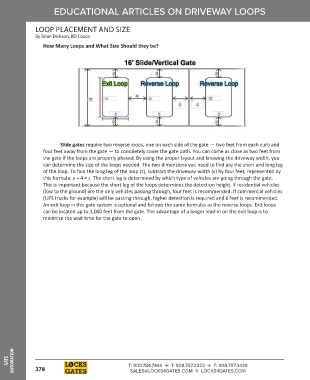
                          Slide gates require two reverse loops, one on each side of the gate — two feet from each curb and
                   four feet away from the gate — to completely cover the gate path. You can come as close as two feet from
                   the gate if the loops are properly phased. By using the proper layout and knowing the driveway width, you
                   can determine the size of the loops needed. The two dimensions you need to find are the short and long leg
                   of the loop. To find the long leg of the loop (z), subtract the driveway width (x) by four feet, represented by
                   this formula: x – 4 = z. The short leg is determined by which type of vehicles are going through the gate.
                   This is important because the short leg of the loops determines the detection height. If residential vehicles
                   (low to the ground) are the only vehicles passing through, four feet is recommended. If commercial vehicles
                   (UPS trucks for example) will be passing through, higher detection is required and 6 feet is recommended.
                   An exit loop in this gate system is optional and follows the same formulas as the reverse loops. Exit loops
                   can be located up to 1,000 feet from the gate. The advantage of a longer lead-in on the exit loop is to
                   minimize the wait time for the gate to open.


                                                                                                           1 | P a ge


       AUTOMATION  378                                T: 800.784.7444    T: 908.757.2323    F: 908.757.3439
    GATE

                                                       SALES@LOCKS4GATES.COM    LOCKS4GATES.COM

